
Making Sense
“A great deal of strategy work is trying to figure out what is going on.
Not just deciding what to do, but the more fundamental problem of comprehending the situation.”
An organisation is a living organism. Like a human being.
It sees. It hears. It smells. It gets touched, impacted. It notices things. It consumes. It produces value and waste.
It is constantly receiving signals in from the outside world.
It interprets them based on what it knows.
It decides what to do. It defines actions. Then it acts.
It acts sometimes wisely, other times blindly.
The results of those actions impact the organisation and then become new signals.
This is a continuous loop.
Or an existence, like life.
Most organisations are busy. Few are clear.
Work is happening everywhere. Decisions are being made. Systems are running. Customers are responding.
But what is actually going on is often hard to see.
We approach this by looking at the organisation as a living system.
Not a machine. Not a set of functions. Not a group of people.
A system that senses, interprets, decides, and acts. Like an organism.
This pattern shows up everywhere. Across a business, within a programme, inside a team, and even in how individuals work day to day.
It is fractal.
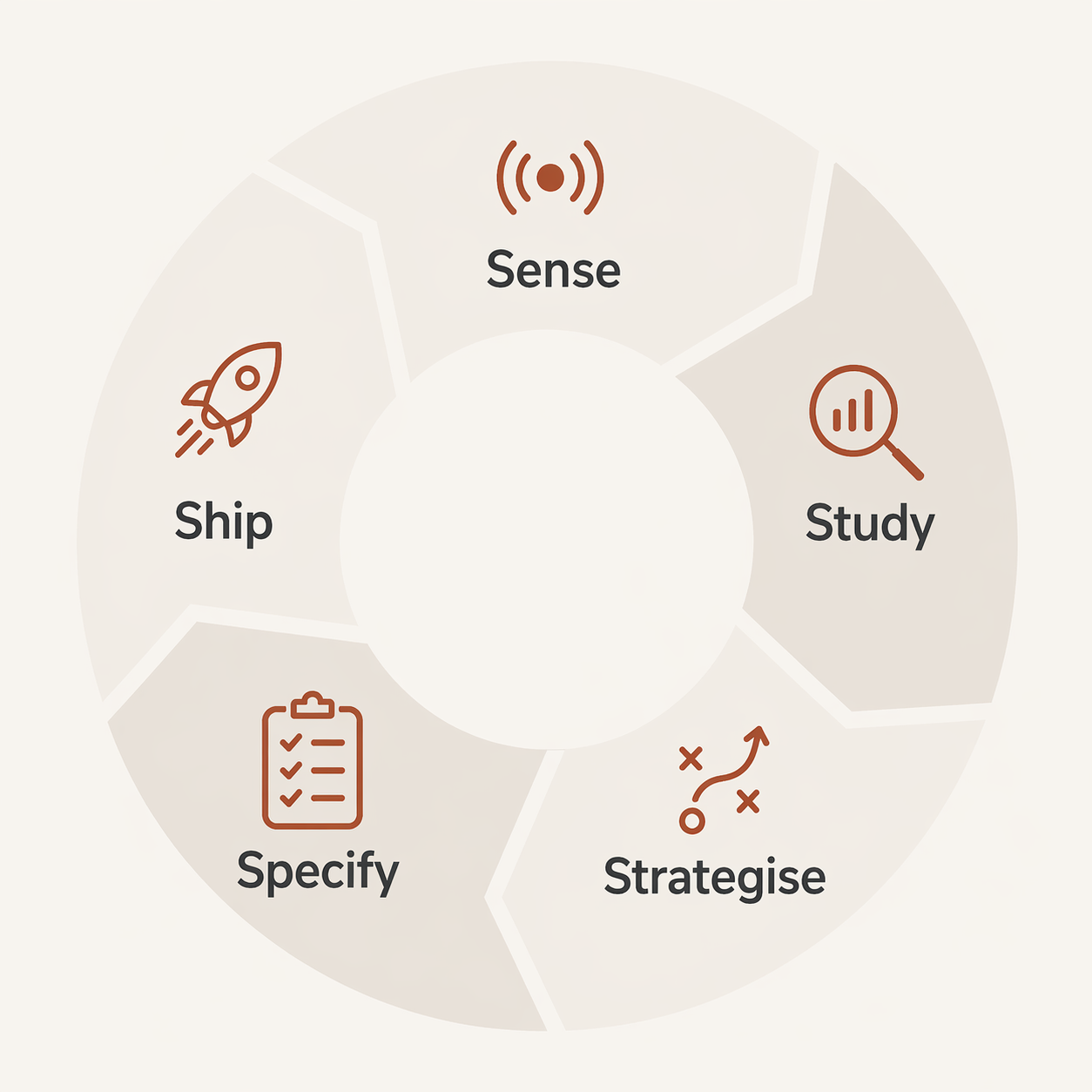
Like a human being, it receives signals through its senses, uses its intelligence to interpret it, decides what to do about it, specifies the action, and then executes it by commanding the body to act.
Thus, an organisation has five systems, through which it delivers value:
Sense → Study → Strategise → Specify → Ship.
Sense
What is the system noticing?
Signals from customers, delivery, operations, and the wider environment.
What is visible. What is ignored. What is delayed.
Study
How is the system making sense of those signals?
Patterns, assumptions, interpretation.
Where meaning is formed, or lost.
Strategise
What choices are being made?
Where to focus. Where to invest. What to prioritise.
Whether decisions are deliberate, or reactive.
Specify
How are decisions translated into work?
Clarity of intent. Definition of outcomes.
How work becomes something that can move.
Ship
What actually gets done?
Delivery, execution, feedback.
What reaches the real world, and what doesn’t.
1. Sense — Seeing, Hearing, Noticing (Research)
In a human, this is the senses.
Sight. Sound. Touch. Internal signals like stress or fatigue.
In an organisation, Sense is everything it is exposed to.
Customer feedback.
Market signals.
Incoming work.
Emails, requests, leads.
Employee feedback.
Frustration, stress, workarounds.
Ideas.
Operational issues.
System data.
What is in progress.
What is stuck.
What is missed.
Also internal state:
Capacity.
Cognitive load.
Pressure.
Noise.
The question is not whether these signals exist.
They always exist.
The question is:
Are they captured?
Are they visible?
Dashboards, reports, systems, workflows — these are not the senses themselves. They are ways of making signals visible.
In many organisations, signals are everywhere, but sensing is weak.
Things sit in inboxes. In people’s heads. In side conversations. In systems that don’t reflect reality.
So the organisation is surrounded by signals, but not really seeing.
Sense is about creating a shared, visible view of reality.
Not interpreted. Not filtered. Just what is happening.
2. Study — Understanding, Interpreting (Analysis)
In a human, this is the brain making sense of what is perceived.
Not everything seen is understood correctly. Interpretation matters.
In an organisation, Study is where sensed inputs are:
Filtered
Classified
Interpreted
Organised
Danger is different from an idea.
A complaint is different from noise.
A pattern is different from a one-off.
This is where:
Signal is separated from noise.
Patterns are identified.
Reality is understood.
This is not private thinking.
This is a visible interpretation layer.
You want one shared reality.
That does not mean one person decides. It means interpretation is structured and visible so people can align around it.
This is where frameworks may be used:
First principles thinking
Jobs to be Done
Constraint awareness
Pattern recognition
This is also where something like Rumelt begins:
Diagnosis — what is actually going on
But this is not full strategy yet. This is understanding.
3. Strategise — Choosing, Deciding (Solutioning)
In a human, this is decision.
Given what is understood, what do we do?
Act.
Not act.
Delay.
Watch.
This is where reaction must be managed.
A system can react impulsively, or respond deliberately.
Strategising is about choosing the course of action.
This includes:
What matters now
What can wait
What should stop
What should be done
This is where:
Capacity
Capability
Resources
Impact
Promisability
are considered.
If you don’t know karate, you won’t choose a karate move.
Available action is shaped by what the system can actually do.
This is where Rumelt comes fully into play:
Diagnosis (from Study)
Guiding policy (how we will approach this)
Coherent actions (what we will do)
Outputs here can be:
Act now
Act later
Do not act
Watch
A decision to not act is still a decision.
4. Specify — Defining Work (Design / Definition)
In a human, this is coordination and planning of movement.
Intent becomes structured action.
In an organisation, this is where decisions become executable work.
Who
How
By when
In what form
This includes:
Work type definition
Triaging
Pipeline design
Stages
Transitions
Inputs required
Responsibilities
This is where people, process, and product come together.
People — who does the work
Process — how work moves
Product — tools, systems, artefacts
This happens at all levels:
A single task
A team workflow
A programme
The organisation
Pipelines are central.
Work enters, moves, transforms, and progresses.
Pipelines often end when value is realised — often when money is in the bank.
Specify is where the system for work is designed.
5. Ship — Acting, Delivering (Delivery)
In a human, this is action.
Movement. Doing. Interaction with reality.
In an organisation, this is where work is actually performed.
This is where value is created.
Not before.
Planning does not create value.
Thinking does not create value.
Defining does not create value.
Doing creates value.
This includes:
Executing work
Running programmes
Delivering services
Building products
Spending approved budgets
Ship continues until value is realised.
In many cases, that means money in the bank.
But it may also include:
Capability
Compliance
Risk reduction
Customer outcomes
The key is:
Value is realised, not just work completed.
The Loop
Once work is shipped:
Results create new signals.
Those signals return to Sense.
The cycle continues.
This is how the organisation lives.
Bringing it together
Most problems in organisations are not isolated issues.
They are breakdowns in this loop.
Signals exist, but are not captured.
Captured, but not understood.
Understood, but not acted on.
Decided, but not properly defined.
Defined, but not executed.
Or executed, but not feeding back into awareness.
Making Sense is where this begins.
Before improving flow.
Before adding systems.
Before automation or AI.
The organisation needs to see.